Hair guide
Curly Hair Types: How to Read Your Waves, Curls and Coils
Curly hair types from 2A waves to 4C coils, with a simple chart, how to find your type at home, and what 2C and 3A curly hair need on wash day.

Curly hair types are a simple way to describe how much bend your hair has, from a soft S wave to a tight zigzag coil. The common chart runs from 2A to 4C. The number tells you the family (2 is wavy, 3 is curly, 4 is coily) and the letter tells you how tight the pattern is within that family, with A the loosest and C the tightest.
Many Indian women grow up thinking their hair is just frizzy or puffy, when it is really 2B or 2C waves that were brushed out every morning. Once you know your type, choosing products and styles gets much easier. Most heads also carry two or three patterns at once: looser at the crown, tighter at the nape and around the face.
Use the chart and the at home check below, then move on to a curly hair routine built for your pattern.
01
Wavy and Loose Curly Hair: 2C and 3A
These two types are the most common on Indian heads and the most often mistaken for straight hair that has gone wrong.

2C waves start close to the scalp and form clear S shapes, with a few loose ringlets underneath. They frizz easily, so they are often mistaken for rough straight hair.
- SuitsType 2C, thick strands
- Time30 minute wash day
- NeedsMousse or light gel
Mirror tipScrunch upward with mousse on wet hair and do not touch while it dries. Brushing dry 2C waves erases them.

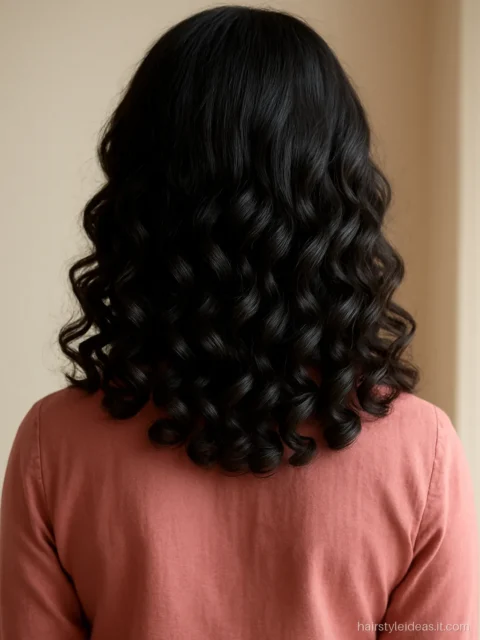
3A curls form round loops about as wide as a thick marker pen. They have shine and bounce but drop and stretch out when weighed down by heavy creams.
- SuitsType 3A, medium density
- Time35 minute wash day
- NeedsLight cream, medium gel
Mirror tipUse a lightweight curl cream and a medium hold gel. Heavy butters pull 3A loops straight within hours.
Curly Hair Types Chart
This chart sums up the main types of curly hair. Sizes are a rough guide, so compare your strands to everyday objects in the mirror.
| Type | What it looks like | Roughly the size of | Common problem | Product weight |
|---|---|---|---|---|
| 2A | Loose, flat bends from mid length | Wide ribbon waves | Goes straight by noon | Very light: mousse, spray |
| 2B | Clear S shape from mid length | Wide S on a page | Flat roots, frizzy ends | Light: mousse, light gel |
| 2C | Deep S from near the roots, some ringlets | Tight S, odd loop | Frizz and puff | Light to medium |
| 3A | Big loose loops | Thick marker pen | Loops stretch out | Light cream, gel |
| 3B | Springy ringlets | Thin marker pen | Dryness, frizz | Medium cream, gel |
| 3C | Tight, dense corkscrews | Pencil | Tangles, dry ends | Rich cream, firm gel |
| 4A | Tight S coils | Knitting needle | Shrinkage, dryness | Rich cream, butter |
| 4B | Z shaped bends, less defined | Folded paper | Breakage | Butter, heavy cream |
| 4C | Very tight zigzags, little clumping | Spring in a pen | Up to 75 percent shrinkage | Butter, oil sealing |
02
Tight Curly Hair Types: 3C and 4A
Tighter patterns shrink the most and need the most moisture. They are less common in India but many women have a band of them at the nape.

3C ringlets are about as wide as a pencil and grow densely, so the hair looks fuller than it is long. Shrinkage can take a mid back length up to the shoulders.
- SuitsType 3C, dense
- Time50 minute wash day
- NeedsLeave in, cream, firm gel
Mirror tipApply products in four sections, not all at once. Dense ringlets at the back are where dry patches hide.

4A coils are tight S springs about the width of a knitting needle. They show the most shrinkage and need the richest creams of all the curly hair types shown here.
- SuitsType 4A, fine to medium
- Time60 minute wash day
- NeedsCream, butter, soft gel
Mirror tipStretch a coil gently to check its real length. Do it on wet hair only, since dry coils snap.
How to Find Your Curl Type at Home
You need one clean wash and a little patience. Do this on a day off, not before an event.
- Wash with a regular or clarifying shampoo to remove old oil and product buildup.
- Condition, then rinse fully. Do not add any leave in, cream, gel or oil.
- Do not comb after rinsing. Squeeze out water gently with a cotton T-shirt.
- Let the hair air dry completely without touching it. Under a fan is fine; a blow dryer is not.
- Stand by a window and look at three places: the crown, the sides near the ears and the nape. Lift a clump from each.
- Match each clump to the chart. Write down all the types you see, for example 2C crown and 3A nape.
Choose products for the tighter type and use less on the looser areas. If your ends are straight while your roots wave, the ends may be heat damaged rather than a different type.
2C Curly Hair in Detail
2C curly hair sits right on the border between wavy and curly. The S shape starts at or near the roots and you will usually find a few true ringlets at the back. It is often thick and coarse in Indian hair, which is why it frizzes so readily in humid weather.
- Main need: definition without weight. Heavy oils and butters drag 2C straight.
- Best products: a light leave in, then a mousse or a light gel. Skip curl cream if the waves fall flat.
- Drying: diffuse on low heat with your head tilted to each side, so the roots lift.
- Watch out for: brushing, which turns 2C into a triangle of frizz, and daily washing, which dries the ends.
3A Curly Hair in Detail
3A curly hair makes big, shiny loops that bounce when you walk. It is the type most people picture when they think of curls. The loops are loose, so they lose their shape if you use too much product or too heavy a product.
- Main need: moisture plus a little hold.
- Best products: a creamy leave in, a lightweight curl cream and a medium hold gel.
- Drying: plop for 10 to 15 minutes, then air dry or diffuse. Do not touch until fully dry.
- Watch out for: sleeping on cotton pillowcases and wearing tight ponytails, both of which stretch 3A loops into waves.
3A curls are long enough at mid back to try most looks in our curly hairstyles gallery, while chin length 3A suits the ideas on short curly hair.
Porosity and Density Matter Too
Two heads with the same type can need very different products. Porosity and density explain why.
Porosity is how easily your hair takes in and holds water. Low porosity hair takes a long time to get wet and a long time to dry, and products sit on top. High porosity hair soaks up water fast, dries fast and frizzes easily; it is common after colour, bleach or a lot of heat. The popular glass of water test is not reliable, because oil and product change the result. A better clue is drying time: if your hair is still damp after five or six hours, it is probably low porosity.
Density is how many strands you have. If you can see your scalp easily when the hair is dry and loose, density is low; use lighter products so the curls do not collapse. High density hair needs more product and works better in sections.
| Your hair | Choose | Avoid |
|---|---|---|
| Low porosity | Light lotions, warm water rinse | Heavy butters, thick oils |
| High porosity | Rich creams, weekly mask, sealing oil | Daily shampoo, high heat |
| Low density | Mousse, light gel | Large amounts of cream |
| High density | Cream plus gel, sectioning | Rushing product through in one go |
Common Mistakes When Reading Your Type
- Judging dry, brushed hair. Brushing breaks up the pattern. Always judge after a product free air dry.
- Expecting one type. Mixed patterns are normal. Plan for the tightest areas.
- Calling heat damage a type. Straight, rough ends on a wavy head usually mean damage from straighteners or rebonding. They may not curl again until they grow out.
- Ignoring the weather. Your curls may look a size tighter in the monsoon and looser in dry winter. Your type has not changed; humidity has.
- Chasing a tighter type. You cannot turn 2A into 3C with products. If you want more curl than you have, read how to get curly hair for setting methods and perms.
Questions people ask
What are the main types of curly hair?
The usual chart has three families: 2 for wavy, 3 for curly and 4 for coily. Each family has A, B and C, from loosest to tightest. Most Indian curly heads fall between 2B and 3B.
How do I know if I have 2C curly hair?
2C waves form a clear S shape starting near the roots, and a few strands at the back curl into ringlets. If your hair frizzes into a puff when brushed but waves when left alone, it is often 2C.
What does 3A curly hair need?
3A loops need moisture and light hold. Use a creamy leave in, a lightweight curl cream and a medium hold gel on soaking wet hair, then leave it alone until fully dry.
Can my curly hair type change?
Your natural pattern can shift a little with hormones, such as after pregnancy, or with age. Damage from heat and chemicals can also loosen curls. Good care often brings back definition that seemed lost.
Is it normal to have more than one curl type?
Yes, very normal. Many women have looser waves on top and tighter curls at the nape and temples. Pick products for the tightest pattern and use less on the looser sections.
Does curl type decide which products to buy?
It is a good start, but porosity and density matter as much. Fine, low density 3A hair may need lighter products than thick 2C hair. See our guide to curly hair products to match textures to your hair.